

Landscape Lexicon: Volcanoes
The volcabulary inspired by Earth's eruptions (mis-spelling intended)

Dear Reader,
There’s a plethora of words and phrases to describe by Earth’s eruptions, both technical and lyrical, that have found their way into the English language. Words that in turn describe the sudden fury of an eruption, and its awe-inspiring destruction, or its dormant, slumbering state. It seems apt that volcanoes, among the most destructive and beautiful of nature’s spectacles, are often invoked when describing life’s most chaotic moments. We often think of them as relatively rare phenomenon — yet the truth is, that volcanoes are ongoing processes that split and weld the Earth into fascinating landforms.
As of 31st March 2026, there were 47 active volcanoes across 25 countries, with 6 of those that began to belch this year, while the others have been active for years [Source]. Curious how we hear of such few volcanoes in global news, or perhaps, politics and global affairs engulf us!
While most volcanoes occur where tectonic plates converge or diverge, that is, clash together or pull apart, some also occur under a plate. Volcanoes that occur where plates diverge or are being pulled away, are non-explosive. Those that occur where plates converge or crash are usually more violent. Intraplate volcanoes are caused when magma rises from a stationary ‘hotspot’ or mantle plume deep within the Earth, and melts through the crust.
I’ve written about volcanoes before, specifically, three of them in Indonesia.
In this edition, I won’t go into depth about the different kinds of volcanoes. Rather, I want to explore the language of volcanoes — words that don’t always find their way into everyday parlance, and some that do, and some that describe the incredible landforms forged by Earth’s deepest smelters.
This format follows other landscape lexicons I’ve written about, in which we’re trying to gather words that describe Earth’s geography, such as wetlands and grasslands. Here’s the volcabulary, inspired by Earth’s fiercest, fieriest phenomenon!

A Journey to the Centre of the Earth
Volcanoes have a deep cultural significance, as they were often attributed to the wrath of the gods. In the New Testament, ‘fire and brimstone' — where brimstone is an archaic term for sulphur, a common volcanic by-product — has been used to denote God's wrath. Among the Maori, Rūaumoko is the god of earthquakes, volcanoes and seasons. Pele is the goddess of volcanoes and fire, and the creator of the Hawaiian islands. Lalahon is the goddess of fire, volcanoes and harvests in the Philippines. The Greeks worshipped Hephaestus and the Romans Vulcan, gods responsible for volcanoes and metallurgy. Some cultures also have deities for specific volcanoes, like Kan-laon in the Philippines who inhabits Mount Kanlaon, or the malignant Guayota, who lives inside the Teide volcano in the Canary islands.
As impressive, indignant natural phenomena, volcanoes have found their way into popular culture. In Jules Verne’s ‘Journey into the Centre of the Earth’, an expedition attempts to reach the planet’s burning core through Iceland’s extinct Snæfellsjökull volcano, and encounter underground oceans and prehistoric life. In J.R.R. Tolkien’s ‘The Lord of the Rings’, Mount Doom or Orodruin, located in Middle-earth, is described as a mountain of blazing fire — a perfect forge to craft and destroy Sauron’s ring of power.
Films like Volcano, Dante’s Peak and the Bond sequel, You Only Live Twice, also featured volcanoes as crucial backdrops. I also vividly remember the character of Stromboli in Disney’s Pinocchio, aptly named after a volcano to represent his volcanic, volatile temper.
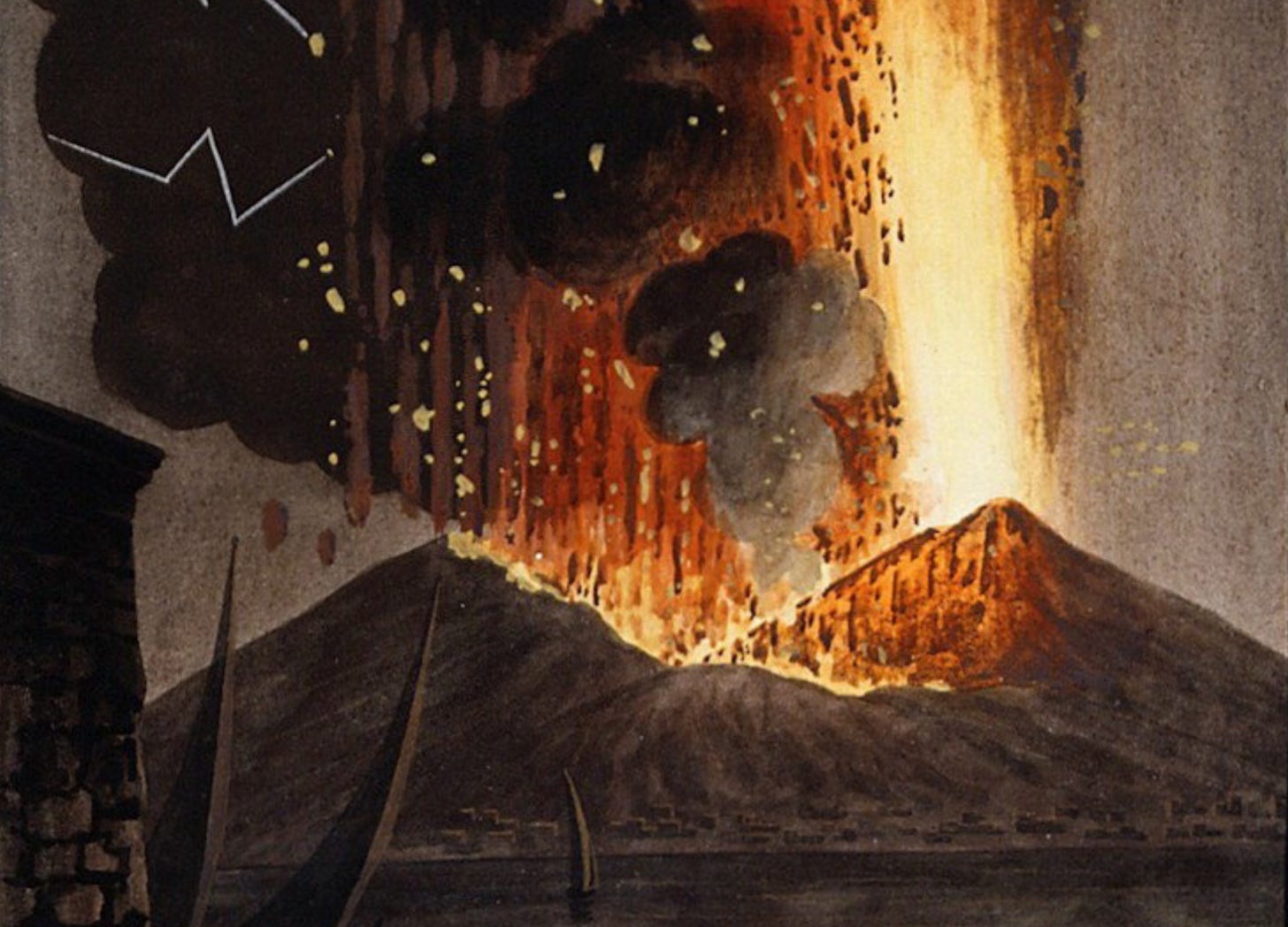
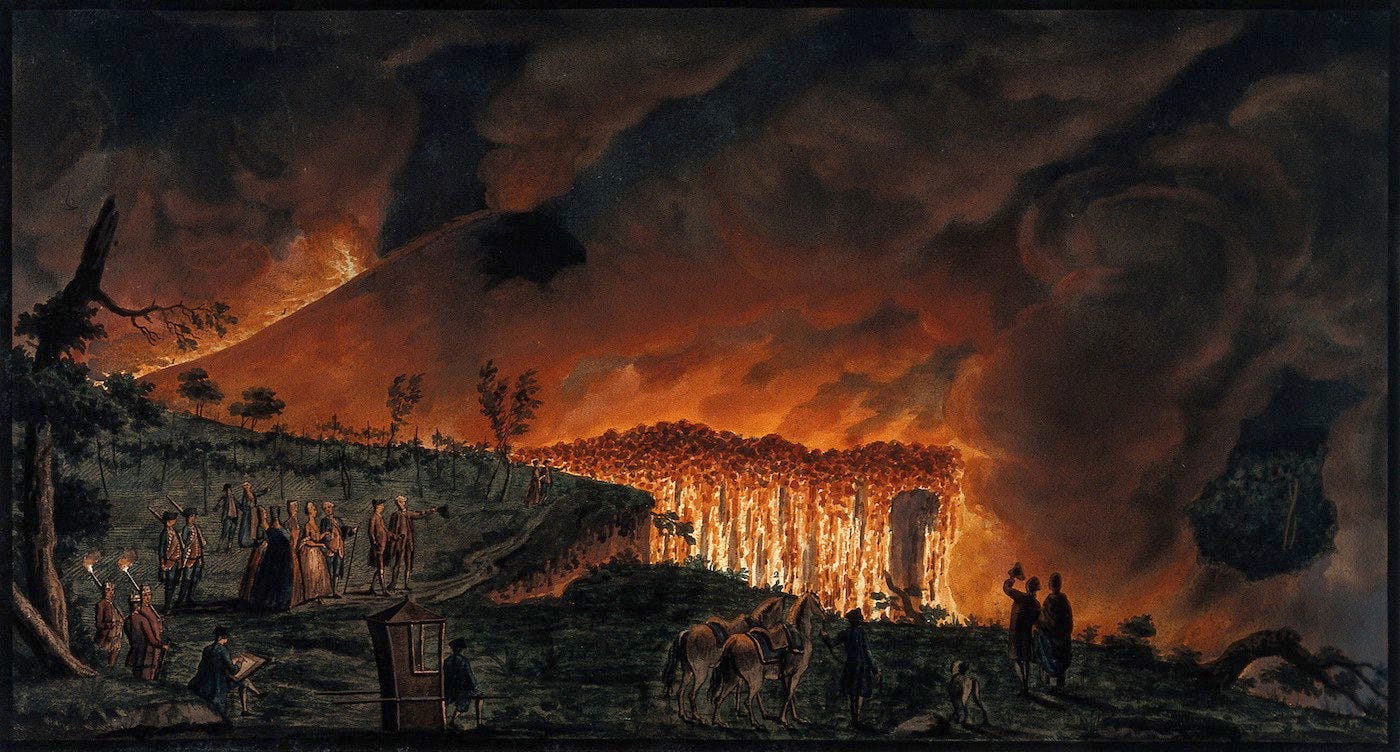
The eruption of Vesuvius has been depicted in art for centuries, from JMW Turner’s fiery landscapes and the 30 studies by Joseph Wright of Derby, to Andy Warhol’s pop art. The 1883 Krakatoa eruption influenced Edgar Degas’ dramatic skies, and the blood-red, apocalyptic skies in Edvard Munch’s The Scream. [Read more on volcanoes in art].
A’a to Xenoliths
The technical terminology includes interesting yet rarely used words that mostly describe lava flows, mineral inclusions, or landscape formations. Here are a few of my favourites (some of which may have been included just because they’re fun to say out loud):
A’a, as the first word in the dictionary, and a two-letter fix in Scrabble, denotes lava flow with a rough or jagged surface formed by highly viscous, cool lava. Pāhoehoe (pronounced as pah-hoh-ey-hoh-ey, or pa-hoy-hoy) has a smooth, ropy, or billowy surface and is formed by low-viscosity, hot lava. Both words originate from Hawaiian, inspired by the volcanic landscapes that shaped the islands.
Breccia is a coarse-grained volcanic rock made up of partially welded angular fragments of material that’s been ejected by volcanoes.
Craters denote the bowl or funnel-like depression where the volcanic vent lies, whereas the cinder cone is the mound created by the ash and cinder around a vent. Crater lakes and calderas form when craters fill with rainwater, melted snow, or groundwater.
Fissures, faults, and fractures are the structural points of weakness that allow the magma to erupt from the mantle to the Earth’s surface. A fumarole is the vent or opening at the surface where volcanic gases and vapours are emitted.
Igneous, a term derived from the Latin words igneus or ignis, meaning fiery or fire, on fire, or burning hot. Some say the Latin words emerged from the Proto-European word for fire, agni. The term entered English usage in the 1660s to describe things resembling fire, and by 1791, it was adopted in geology to describe rocks formed by cooling from a molten state. Other terms, like volcanic or plutonic to denote the same fire-born rocks, were inspired by Roman gods of the hearth and the underworld, Vulcan and Pluto.
A lahar is a mixture of water and fine volcanic debris that moves rapidly down a volcano's slope as a kind of mudflow. Their composition means they behave like wet concrete and are extremely destructive, capable of burying towns, destroying infrastructure, and altering river landscapes, often long after an eruption has ended. Similarly, a pyroclastic flow is a fast-moving current of hot gas, ash, and rock that travels downhill at high speeds, sometimes exceeding 100 km/h.
Lava is the molten or solidified magma that has erupted onto the surface of the Earth, whereas magma is what lies beneath the surface. ‘Lava’ is often prefixed to a variety of other words, like blister, dome, lake, flow, tube, to describe the formations created by volcanoes. Like me, you might also enjoy the word ‘laze’, short for lava haze — a cocktail of condensed seawater steam, hydrochloric acid gas, and shards of volcanic glass produced when lava boils seawater to dryness.
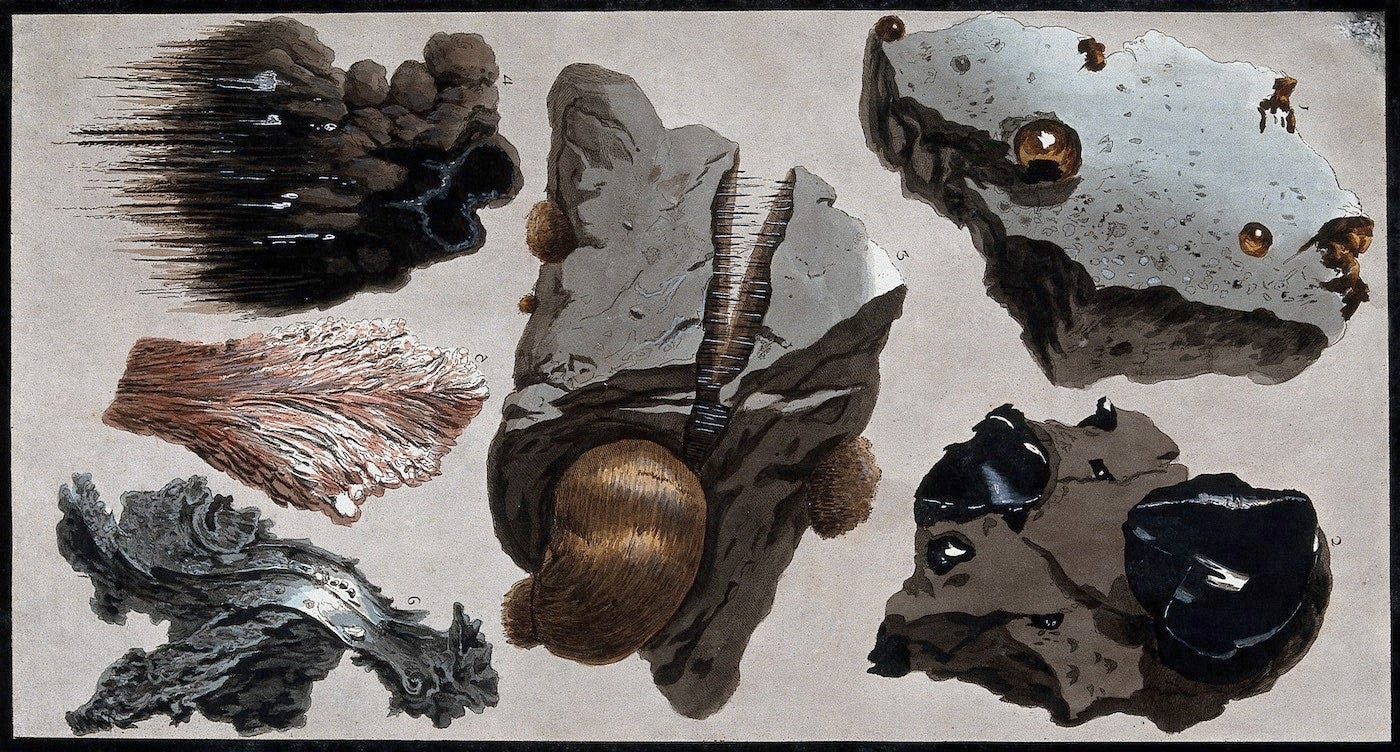
Interesting volcano-related mineral names include hornblende mica, obsidian, olivine, porphyry, and pumice — each carries its own story about the volcanoes that shaped them.
Volcanic eruptions also result in incredible formations. In active volcanic regions, hotsprings and geysers occur when groundwater is heated by shallow magma, resulting in intermittent eruptions of steam and water. If such eruptions occur deep underwater, the saltwater cools the lava very quickly, giving rise to spherical or bubble-like pillow lava. If such submarine or underwater eruptions bubble to the surface, and the magma cools slowly and cracks, it may contract into hexagonal columns, known as basalt columns or columnar jointing.
I’d written about the columnar joints at St Mary’s island in Udupi, which formed as a result of the unzipping of Madagascar and India:

Some half-familiar words that you may not have known were of volcanic origin:
Hotspot where a plume of hot mantle material rising from deep within the Earth over which volcanoes occur; used to denote biodiversity hotspots, wifi-connectivity points, inflammations and health outbreaks, or areas of political unrest.
Perlite is a volcanic glass that’s found its way into toothpastes and as a soil additive!
Vitreous or vitric, denotes having the luster and appearance of glass, is often used to market a particular glass-like ceramic finish on bathroomware.
Lastly, xenoliths, originating from the Greek word for ‘strange rock’, are foreign rock fragments embedded within igneous rocks, formed when magma breaks off and incorporates surrounding rock as it breaks through to the surface. Such inclusions are samples of the Earth's deep crust and mantle (up to 300 km deep).
Supervolcanoes
As with earthquakes, volcanic intensity is also measured on a logarithmic scale, aptly called the volcanic explosivity index (VEI). A logarithmic scale means that intensities multiply rather than add. With the VEI, there’s a 10-fold increase in explosivity, meaning VEI 1 is 10 times more explosive than a VEI 0; VEI 2 is 10 times more explosive than a VEI 1; and so on. Lower VEI eruptions (0–2) are common, and occur nearly every year, whereas VEI 7-8 events are rare, and occur every 1,000 to >10,000 years.
Supervolcanoes are the rare, 8-magnitude eruptions, capable of flinging volcanic material over 1,000 cubic kilometres! They often form when magma rises from a hotspot but fails to break through the crust, creating a massive, pressurised magma chamber that eventually causes the surface to crumble and collapse.
Modern history’s catastrophic volcanoes include the Hunga Tonga–Hunga Haʻapai submarine volcano in 2022 (VEI 5-6), located in the South Pacific, a part of the Tonga-Kermadec Islands volcanic arc, the Pinatubo earthquake in 1991 (VEI 6) in the Philippines, and Mount St. Helens in 1980 (VEI 5), in the USA.
Yet Earth’s most recent supervolcano is New Zealand's Taupō Volcano, which erupted around 25,600 years ago. Other supervolcanoes include Indonesia’s Toba eruption around 74,000 years ago and multiple eruptions around 2.1 and 1.3 million years ago at the USA’s Yellowstone Caldera, which is still active today! So why are past supervolcanoes important? The massive ash deposits can sometimes serve as markers when studying archaeology or palaeontology!
Researchers have found a layer of volcanic ash at the Dhaba locality in Central India, dated to the Toba eruption, 74,000 years before present-day. Dhaba is located over 3,000 kilometres (~1864 miles) as the crow flies from Indonesia’s Lake Toba. If that isn’t astonishing enough, they’ve found remnants of stone tools both above and below the ash layer — indicating that human settlements not just arrived and thrived in Central India before 74,000 years, but that they persisted even after the supervolcano erupted.
In the USA, the ancient Yellowstone plumes have been instrumental in preserving Cenozoic fossil formations, such as the John Day Formation in Oregon, where over 100 species of mammals have been identified, including prehistoric ancestors of camels, cats, dogs, hogs, and horses.
As the Milky Way was forged in fire, Earth isn’t the only planet with volcanoes — Venus is largely comprised of basalt, hinting at volcanic processes, we’ve detected extinct volcanoes on Mars, and the moons of Jupiter and Neptune bear cryovolcanoes, or icy furnaces that erupt in liquid nitrogen, ammonia, and hydrocarbons (yes, water too!)
RELATED ARTICLE:


Wow..thank you for such a fascinating vocabulary :)
This has been delved into quite well. Thank you.